what are some of the structures inside a cell that help it to live and perform in an organism
Creature Jail cell Biology
Cells are the structural and functional unit of all living organisms. Some organisms, such as bacteria, are unicellular , consisting of a single cell. Other organisms, such as humans, are multicellular , or take many cells�an estimated 100,000,000,000,000 cells! Each cell tin can take in nutrients, catechumen these nutrients into energy, carry out specialized functions, and reproduce as necessary. Even more astonishing is that each prison cell stores its own set of instructions for carrying out each of these activities.
Cell System
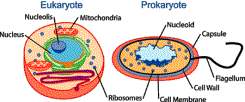
It is important to know what organism the cell comes from. There are two full general categories of cells: prokaryotes and eukaryotes . Prokaryotes are capable of inhabiting almost every identify on the earth, from the deep body of water, to the edges of hot springs, to merely about every surface of our bodies. Prokaryotes also lack any of the intracellular organelles and structures that are characteristic of eukaryotic cells. Most of the functions of organelles, such as mitochondria and the Golgi apparatus, are taken over past the prokaryotic plasma membrane. Eukaryotes are almost 10 times the size of a prokaryote and can be as much as 1000 times greater in volume. The major and extremely significant difference betwixt prokaryotes and eukaryotes is that eukaryotic cells incorporate membrane-bounded compartments in which specific metabolic activities take place, and have small specialized structures called organelles that are dedicated to performing certain specific functions. Most important amongst these is the presence of a nucleus , a membrane-delineated compartment that houses the eukaryotic cell�s Deoxyribonucleic acid.
Cell Structures: The Nuts
The Plasma Membrane�A Cell'southward Protective Glaze
The outer lining of a eukaryotic cell is chosen the plasma membrane . This membrane serves to dissever and protect a prison cell from its surrounding environment and is made mostly from a double layer of proteins and lipids, fat-like molecules. Embedded inside this membrane are a multifariousness of other molecules that act as channels and pumps, moving different molecules into and out of the cell. A form of plasma membrane is also constitute in prokaryotes, but in this organism it is usually referred to as the jail cell membrane .
The Cytoskeleton�A Cell's Scaffold
The cytoskeleton is an of import, circuitous, and dynamic prison cell component. It acts to organize and maintain the cell's shape; anchors organelles in place; helps during endocytosis (the uptake of external materials by a cell); and moves parts of the cell in processes of growth and motility. At that place are a peachy number of proteins associated with the cytoskeleton, each controlling a cell�s construction by directing, bundling, and adjustment filaments.
The Cytoplasm�A Cell's Inner Infinite
Inside the prison cell there is a large fluid-filled infinite called the cytoplasm , sometimes called the cytosol . In prokaryotes, this space is relatively free of compartments. In eukaryotes, the cytosol is the "soup" within which all of the jail cell's organelles reside. It is besides the dwelling house of the cytoskeleton. The cytosol contains dissolved nutrients, helps break down waste product products, and moves material effectually the cell. The nucleus oft flows with the cytoplasm changing its shape as information technology moves. The cytoplasm also contains many salts and is an excellent conductor of electricity, creating the perfect environs for the mechanics of the jail cell. The role of the cytoplasm, and the organelles which reside in it, are critical for a jail cell'south survival.
Genetic Cloth
Two different kinds of genetic material be: deoxyribonucleic acid (DNA) and ribonucleic acid (RNA). Almost organisms are made of DNA, but a few viruses take RNA equally their genetic cloth. The biological information contained in an organism is encoded in its DNA or RNA sequence.
Prokaryotic genetic material is organized in a elementary circular construction that rests in the cytoplasm. Eukaryotic genetic material is more circuitous and is in units called genes . The nuclear genome is divided into 24 Dna molecules, each contained in a different chromosome .
Organelles
The human trunk contains many different organs, such as the heart, lung, and kidney, with each organ performing a different part. Cells also have a set of "little organs", called organelles , which are adapted and/or specialized for carrying out ane or more than vital functions. Organelles are establish but in eukaryotes and are always surrounded by a protective membrane. It is important to know some basic facts about the post-obit organelles.
The Nucleus�A Cell's Heart
The nucleus is the most conspicuous organelle found in a eukaryotic cell. It houses the jail cell'southward chromosomes and is the place where about all Deoxyribonucleic acid replication and RNA synthesis occurs. The nucleus is spheroid in shape and separated from the cytoplasm by a membrane chosen the nuclear envelope . The nuclear envelope isolates and protects a cell'south Deoxyribonucleic acid from diverse molecules that could accidentally damage its structure or interfere with its processing.
The Ribosome�The Protein Production Car
Ribosomes are found in both prokaryotes and eukaryotes. The ribosome is a big complex composed of many molecules, including RNA and proteins, and is responsible for processing the genetic instructions carried past mRNA. Poly peptide synthesis is extremely important to all cells, and therefore a large number of ribosomes�sometimes hundreds or even thousands�can be institute throughout a prison cell.
Ribosomes float freely in the cytoplasm or sometimes bind to another organelle called the endoplasmic reticulum.
Mitochondria--The Power Generator
Mitochondria are cocky-replicating organelles that occur in various numbers, shapes, and sizes in the cytoplasm of all eukaryotic cells. Mitochondria contain their own genome that is separate and distinct from the nuclear genome of a cell. Mitochondria have 2 functionally singled-out membrane systems separated past a infinite: the outer membrane, which surrounds the whole organelle; and the inner membrane, which is thrown into folds or shelves that projection inward. These inwards folds are called cristae . The number and shape of cristae in mitochondria differ depending on the tissue and organism in which they are found, and serve to increase the surface area of the membrane. Mitochondria play a critical office in generating free energy in the eukaryotic prison cell, and this process involves a number of complex pathways. They are the powerhouses of the cell.
The Endoplasmic Reticulum and the Golgi Apparatus�Macromolecule Managers
The endoplasmic reticulum (ER) is the send network for molecules targeted for certain modifications and specific destinations, equally compared to molecules that will bladder freely in the cytoplasm. The ER has two forms: the crude ER and the smooth ER . The rough ER is labeled as such because it has ribosomes adhering to its outer surface, whereas the smooth ER does not. The smooth ER serves as the recipient for those proteins synthesized in the crude ER. Proteins to be exported are passed to the Golgi apparatus , sometimes called a Golgi trunk or Golgi complex , for further processing, packaging, and transport to a variety of other cellular locations.
Lysosomes and Peroxisomes�The Cellular Digestive Organization
Lysosomes and peroxisomes are often referred to as the garbage disposal arrangement of a cell. Both organelles are somewhat spherical, bound by a single membrane, and rich in digestive enzymes , naturally occurring proteins that speed up biochemical processes. For example, lysosomes tin can contain more than than three dozen enzymes for degrading proteins, nucleic acids, and sure sugars called polysaccharides. Here we can run into the importance behind compartmentalization of the eukaryotic prison cell. The cell could non house such subversive enzymes if they were not contained in a membrane-bound arrangement.

Animate being Cell
 |
Notation: The animal eukaryotic cell concept map is based upon this commodity, and these two are meant either to be given out as homework or to be done in class equally a team exercise to fill up in the concept map blanks. I call back it is all-time utilized equally a normal homework assignment to analyze in the students� minds exactly how the parts of the cell are connected.
Source: https://www.bu.edu/gk12/nishant/cellbioarticle.htm
0 Response to "what are some of the structures inside a cell that help it to live and perform in an organism"
Postar um comentário